Showing posts with label vintage film. Show all posts

Wednesday, January 7, 2026

Live it up! 11 essential nightclubs of noir

Karen Morley, 'Scarface' (1932).

By Paul Parcellin

In noir, nightclubs are smokey hideaways where criminality thrives under moody lighting. Ritzier than typical barrooms, they are havens for hedonists and the racketeer elite. 

Crucial to these nightspots are floorshows. A chanteuse may whisper a torch song designed to torment an ex-lover sitting ringside. Her words spell out jagged details of his predicament, defining his emotional state or perhaps the moral decay that engulfs him. 

In noir, entering a nightclub is like stepping into hell’s waiting room. It may be steamy and dazzling at first, but all exits lead to damnation. 

Here are the top 11 nightclubs of noir, hot spots where the underworld cools its heels and lives are sometimes broken: 

Osgood Perkins, Paul Muni, Karen Morley, 'Scarface.'

Scarface’ (1932)

The Paradise is everything a swank gangster nightclub should be: an orchestra wails swing jazz numbers, swell looking couples fill the dance floor, guys are clad in their formal best, ladies sway to the rhythm in chic evening dresses. Wiseguys Johnny Lovo (Osgood Perkins) and Tony Camonte (Paul Muni) spar over glamor girl Poppy (Karen Morley) — Tony, an upstart, comes out on the winning end, but egos are bruised. “Scarface” wasn’t the first crime movie to use a nightclub setting, but it sure knows how glamorize the seductive charm of such establishments. Without warning, shots are fired, a gunman is subdued, the orchestra plays on and patrons carry on unruffled. How gangster can you get?

Roger Duchesne, 'Bob le Flambeur.'

Bob le Flambeur’ (1956) (‘Bob the Gambler’)

Bob Montagné (Roger Duchesne) is a former bank robber earning his keep at all night poker matches and other games of chance. A suave sophisticate, he’s respected as a prince among thieves. No one can cross a cafe floor and command the respect Bob receives from fellow larcenists, gamblers and even the police. His nightclub of choice is Jour et Nuit (Day and Night), but he’s a creature of the latter. Sleeping when the sun rises, he only comes alive when the lights of Montmartre twinkle at dusk. Parisian cafes, bars and nightclubs are his domain. When his luck turns bad he looks for alternative means to pay his debts. That one last big score is the thing that tempts graying outlaws, even retired ones, and Bob is no exception. 

Frank Bigelow (Edmond O'Brien) puffs on a cigarette
at the Fisherman. 'D.O.A.' (1949)

D.O.A.’ (1949)

 Calling San Francisco dive bar the Fisherman a “nightclub” is stretching the definition of the term until it screams. But the F’man’s got a stomping jazz sextet that cannot be denied a mention here. The joint’s a beatnik hangout where straight-arrow accountant Frank Bigelow (Edmond O’Brien) wanders in and sips a beverage that changes his life forever. The place is a seething mass of hipsters grooving to the bebop beat as the band blows a frenzied set that sends the bohemian crowd into orbit. The atmosphere is claustrophobic and the scene teeters on chaos, much like Frank’s immediate future.

Edward G. Robinson, 'Little Caesar.'

Little Caesar’ (1931) 

The hoods hang out upstairs at Club Palermo, a gangster stronghold in the big city. Stickup man Caesar Enrico “Rico” Bandello (Edward G. Robinson) pokes his beak in to talk with crime boss Sam Vettori (Stanley Fields), who runs the club and uses it as a front for his illegal operations. Rico passes muster and is immediately introduced to the rest of the gang. Besides being an entertainment spot for the corrupt, the club becomes the incubator that helps Rico launch his criminal career. At the club downstairs he eventually commits a brazen and violent act in public that shakes up the city’s mobster elite and catapults him to the top of the syndicate.  

Cathy Rosier, Alain Delon, François Périer, 'Le Samouraï.'

Le Samouraï’ (1967)

Martey's, an upscale Parisian jazz lounge, attracts a more refined crowds than do other nightspots mentioned here. But criminals operating behind the scenes are a continuous presence there. Hired killer Jef Costello (Alain Delon) visits the establishment to carry out some business for an employer. He isn’t the kind of assassin you’d expect him to be. Jef lives the austere life of a Buddhist monk and adheres to the code of the samurai. He’s an outsider among criminals in this nocturnal playground. Vocalist and keyboard player Valérie (Cathy Rosier), who performs at the club, witnesses something she wasn’t meant to see, and Jef soon finds that he’s the one being hunted.

Richard Widmark, Mike Mazurki, 'Night and the City.'

Night and the City’ (1950)

The Silver Fox nightclub sits among the cheap clip joints of London’s Soho district. It’s where low rent hustler Harry Fabian (Richard Widmark) hangs out, ever on the lookout for a fast buck or a get rich quick scheme. Harry uses his gift for gab to pry loose greenbacks from the unwary, especially his lady friend. He’s in his element at the Silver Fox, a place where bar girls fleece tipsy customers, sweet talking them into buying overpriced champagne and chocolates. Everyone there is either a crook or a victim. Beneath his bravado, Harry fears he’ll ultimately be one of the latter. When he schemes to become a professional wrestling promotor things don’t go his way. Unfortunately for him, he’s burned too many bridges to get a free pass this time.

Humphrey Bogart, Lauren Bacall, 'The Big Sleep.'

The Big Sleep’ (1946)

Crime kingpin Eddie Mars’s Cypress Club plays host to the denizens of a dark side. In it, illegal gambling is the main attraction and all things illicit are for sale. In between crooning pop tunes for the punters, rich girl Vivian Sternwood (Lauren Bacall) tries her luck in the casino. When she pockets a thick wad of cash at the roulette wheel she nearly gets robbed, but private dick Philip Marlowe (Humphrey Bogart) steps in and saves her bacon. Their liaison leads to a well remembered steamy conversation of double entendres involving race horses and jockeys. The Cypress is not the kind of place where Vivian or her younger sister, Carmen (Martha Vickers), should frequent, but these girls do love trouble.

Richard Widmark, Ida Lupino, 'Road House.'

Road House’ (1948)

Jefty's Road House isn’t a swank, big city club. It’s a backwater joint with a bowling alley. A love triangle with Chicago songstress Lily Stevens (Ida Lupino), club owner Jefty Robbins (Richard Widmark) and club manager Pete Morgan (Cornel Wilde) sets the drama in motion. In one of its best scenes, Ida Lupino makes a lukewarm crowd sit up, take notice and applaud when she sings “One for My Baby (and One More for the Road).” She isn’t a trained vocalist, and her slightly raspy two-pack-a-day voice radiates a world-weary sense of dissatisfaction, which is what makes the scene work. It’s all about heartache and raw emotions and she’s got a hell of a story to tell.

Raymond Burr, 'The Blue Gardenia.'

The Blue Gardenia’ (1953)

Loneliness seems to float in the air like clouds of cigarette smoke as Nat King Cole warbles the film’s title song in the softly-lit Blue Gardenia club, a South Seas-themed watering hole. It’s a romantic setting, but one couple is having a difficult time of it. Calendar artist Harry Prebble (Raymond Burr) plies Norah Larkin (Anne Baxter) with cocktails. Norah hesitates to imbibe, but Harry is insistent. The music and atmosphere reflect the isolation Norah feels, and the club resonates her emotional distress. Matters get worse when a dark crime is committed and a memory blackout obscures the events of the previous evening.

Magali Noël, 'Rififi.'

Rififi’ (1955)

L’age d’Or (The Golden Age) is an ironically appropriate name for the nightclub of choice for a band of French jewel thieves who are casing out a stronghold of precious stones. Aging gangster Tony "le Stéphanois" (Jean Servais) is persuaded by his buddies to help rob an exclusive jewelry dealer. Tony wants to go for a bigger score than just the ice in the store window: their target switches to the retailer’s highly secure vault. It’s a flawless plan, or so they think, but relationships with women in their lives complicate matters. Viviane, a chanteuse at the club, performs the film’s memorable title song, describing the plight of a woman in a relationship with a roughneck gangster. She ought to know — her beau is in on the heist.

Rita Hayworth, Glenn Ford, 'Gilda.'

Gilda’ (1946)

Rita Hayworth’s iconic hair toss helps make her vocal rendition of “Put the Blame on Mame” sizzle in what is perhaps the greatest noir nightclub moment of all time. She’s voluptuous, self assured and more than a bit dangerous. The scene is packed with drama as Johnny Farrell (Glen Ford) looks on with fury and ringsiders scramble for the gloves and necklace she tosses their way. Make no mistake, she weaponizes her performance in a psychological battle with Johnny and her husband, Ballin Mundson (George Macready). When she asks the gentlemen in the house to help undo the back of her black strapless gown she may as well be lighting the fuse on a powder keg.


Thursday, September 25, 2025

Mark Stevens: his quartet of searing films noir still light up screens today

Lucille Ball, Mark Stevens, 'The Dark Corner' (1946).

By Paul Parcellin

Mark Stevens made a string of taut crime dramas in the 1940s and ’50s that still resonate today. He acted in dozens of films, from westerns, war pictures to musicals and comedies, and directed two of his self-produced noirs as well as some hardboiled television series.

Born Richard William Stevens in 1916, he adopted "Mark" as his show business handle after Daryl Zanuck suggested he take on Dana Andrews’s character's name in “Laura.” His family lived briefly in Cleveland before his parents divorced and his mother brought him to England. She remarried and they settled in Montreal

A devastating injury

In his youth Stevens distinguished himself in competitive swimming and diving until he severely injured his back in a diving accident. He endured a number of surgeries that eventually returned him to normal mobility but his injury kept him out of the service. While convalescing he frequented movie houses and developed a love of cinema.

His first acting roles were in community theater and he later performed with a stock theater company. Setting his sights on the big time, he moved to New York but fell upon hard times and returned home to Montreal. He saved his pennies and bought a train ticket to California where Warner Brothers eventually gave him a screen test and made him a contract player. 

On the screen, then out the door

He appeared in “Destination Tokyo” (1943) with Cary Grant and John Garfield, and “Objective, Burma” (1945) with Errol Flynn. After two years of bit roles he complained to the studio’s top dog Jack Warner that his career wasn’t advancing as quickly as he’d like. Warner rebuffed him, and in protest Stevens played hooky from his job, after which the studio dropped him. 

But as one door slammed shut another opened at 20th Century Fox, where among other projects, he acted in a pair of solid noirs, “The Dark Corner” (1946), and “The Street with No Name” (1948). 

A promising start with Fox

Eager to capitalize on the surprise hit, “Laura” (1944), Fox assembled a similar array of characters for “The Dark Corner” with Stevens in the role of  Bradford Galt, an inexperienced yet somehow world-weary and cynical private eye. His recent hire, secretary Kathleen Stewart (Lucille Ball), is perky, wise cracking and street smart — just the kind of gal for Galt. Five years before her “I Love Lucy” debut, Ball gives us a taste of her acting chops and a touch of slapstick comedy — keep an eye out for the scene in which when she swings wildly in a batters cage. 

The story gets cracking when Galt slaps around a mug in a white linen suit (William Bendix) who’s been tailing him. Of course, that’s not the last he sees of Bendix, who turns in his signature tough guy performance. 

Different story, familiar characters

The story revolves around effete art dealer Hardy Cathcart (Clifton Webb), Galt’s former partner, Tony Jardine (Kurt Kreuger), and Cathcart’s wife, Mari (Cathy Downs). Webb is virtually repeating his role as acid-tongued gossip columnist Waldo Lydecker in “Laura.”  Alas, Ball, Webb and Bendix steal every scene they’re in, but Stevens still makes a strong enough, if not stellar, showing as the jaded shamus. 

Top of the heap, at last

He finally gets top billing in “The Street with No Name,” but, once again Stevens is both blessed and cursed to appear alongside co-star Richard Widmark. Widmark’s on-screen charisma is like a blindingly brilliant light that leaves Stevens’s solid performance a bit in the shadows. 

Richard Widmark, "The Street with No Name" (1948).

G-man goes undercover

In “The Street with No Name” FBI agent Gene Cordell (Stevens) infiltrates a vicious gang operating in a seedy anywhere-America city. Head crook Alec Stiles (Widmark) runs a boxing gym and commands a band of robbers.  Lloyd Nolan plays the same FBI Inspector Briggs of “The House on 92nd Street” (1945) and Ed Begley is the police chief. 

The film’s stunning look, crafted by cinematographer Joseph MacDonald, creates shadowy dive hotel rooms, dark, forbidding alleyways and menacing skid row streets with astonishing artistry.

Gunplay and fisticuffs

It’s a tight action drama with a slug-fest boxing match and a noir shootout, appropriately, in a gloomy factory.  Unfortunately, Stevens apparently didn’t live up to Fox’s expectations of a leading man and loan-outs to other studios began until his contract lapsed.

After Fox, he found work with the “three little majors,” Universal, Columbia and United Artists, and with low-budget B-movie factories on Poverty Row. Most notably he appeared in a noir for Columbia, “Between Midnight and Dawn” (1950), with Edmond O’Brien, in which he plays a rookie cop paired with O’Brien, patrolling city streets on the graveyard shift.

Mark Stevens, Edmond O'Brien, "Between Midnight and Dawn" (1950).

Cops in a radio car 

The film is a police procedural wrapped around a buddy movie with a documentary style opening. The film’s staccato newsreel-like footage gives way to a smoother paced story of police officers trying to tame the influence of organized crime in their city. A sub-plot offers some rickety comedy involving Stevens’s Rocky Barnes awkwardly wooing police radio dispatcher Katherine Mallory (Gale Storm). The light humor seems inconsequential, but Katherine becomes more significant to the film’s emotional backbone in the later part of the story. 

The green and the disillusioned

O’Brien’s Patrolman Daniel Purvis is street smart and cynical, while Barnes is as yet unscathed by bitter experience on the force. When the crime fighting duo arrest racketeer Ritchie Garris (Donald Buka) things get serious and a revenge drama is set in motion. The cast turns in solid performances all around as the film comes to a tense climax.

 After “Between Midnight and Dawn,” television roles followed for Stevens. In 1953 he took over the lead role in NBC-TV’s detective drama “Martin Kane.” He stayed with the show just one season, 40 episodes, but it provided him the security of a steady paycheck as he made plans for the future.

Mark Stevens, Trudy Wroe, "Big Town" (1954).

A leap into ‘Big Town’

It was a big risk, but the following year Stevens bought a half-stake in the TV series “Big Town” (1950-1956). The series, which ran on CBS (1950-1954) and NBC (1954-1956), is built around a crusading news reporter fighting corruption. Stevens appeared in 82 episodes. In his second season he began writing, directing and producing episodes, which would prove to be a key to his later success in film and television.
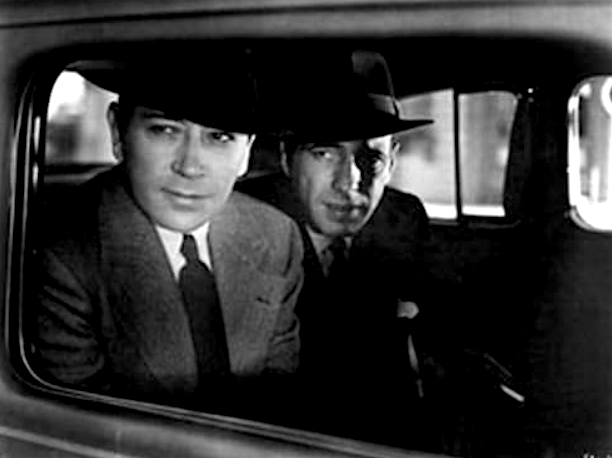
Out for revenge

Back on the big screen, Stevens directed and starred in “Cry Vengeance” (1954), a revenge thriller he made for Allied Artists, formerly Monogram Pictures. In it, San Francisco ex-cop Vic Barron (Stevens) is haunted by his past. He crossed mobster Tino Morelli (Douglas Kennedy) and soon thereafter his family was killed in a car bombing that left him disfigured. The mobster framed him for a crime he didn’t commit and Barron served three years in prison. 

We meet him as he’s released from lockup and filled with a desire for vengeance on Morelli. But is he after the right man? Barron’s search for the culprit brings him all the way to Alaska, but finding the perpetrator behind the bombing proves more complicated than he anticipated.

Mark Stevens, "Cry Vengeance" (1954).

A company of his own

Following “Cry Vengeance, he formed Mark Stevens Productions in 1955 with ambitious plans for films and TV series as well as an expansion into the music publishing and record distribution businesses. Most of these ventures didn’t pan out, with the exception of the noir “Time Table” (1956). This time, Stevens directs and stars, playing insurance cop  Charlie Norman who is assigned to investigate a train heist that turns out to be more than what meets the eye. 

Robbery on the rails

The gang pulls off a complicated railway robbery that depends on adherence to a strict timetable — if one move goes wrong a chain reaction would quash the caper. The film features a gripping 10 minute robbery sequence that showcases Stevens’s directing style. We learn about Charlie, who’s obsessed with status and material wealth. He’s jumpy and craves success — perhaps a bit like the real-life Stevens. He spells it all out in a short burst of anti-establishment dialogue: “For me, patience in poison!”

Just one film completed

The taut thriller would be Mark Stevens Productions’s lone completed  project. It’s unclear what exactly brought about the company’s demise, although it’s likely that Stevens invested too heavily in his productions. “Time Table” stands as a shining example of Stevens’s craft (at times, he claimed the company produced others).

Off to distant shores

The production company’s failure was enough to make Stevens flee to Majorca, Spain, where he eventually retired. Throughout the late 1950s and 1960s he returned to the states periodically for TV guest spots, mostly on westerns. He appeared in “Fate is the Hunter” (1964) with Glenn Ford, and back on the continent he appeared in a string of forgettable European movies.

He popped up now and again in TV guest spots on “Kojack,” “Simon and Simon” and “Magnum, P.I.” His final TV appearance came in 1987. He died of cancer in 1994 at age 77.


Wednesday, May 28, 2025

‘Out of the Past’: 13 Signs that Jane Greer is About to Destroy You

Jane Greer, 'Out of the Past' (1947). Dressed in mink and deadly.

Warnings abound,
but the only thing
Mitchum can sputter
is 'Baby, I don’t care'

Contains spoilers

By Paul Parcellin

Out of the Past’ (1947)

You can’t say that Jeff Bailey (Robert Mitchum) had no way of knowing what he was in for. A shamus ought to be able to see things that a civilian would miss, even when he’s dazzled by the gorgeous and perfidious Kathie Moffat (Jane Greer). How inevitable was it that love smitten Jeff would step off the edge of a cliff once he met this dame? If the sweet-talking Kathie were a  bottle of cologne her scent would be called “Eau de Damnation.”

Jeff is a former private detective who lives in a small town under an assumed name. We soon learn why he’s gone into hiding. Through a quirk of fate he’s forced to see his loathsome former boss, gambler Whit Sterling (Kirk Douglas), in Lake Tahoe. On his way there, Jeff spills the back story to his girlfriend Ann Miller (Virginia Huston), who comes along for the ride, and we see the story in a long flashback sequence. 

Three years before, Sterling hired Jeff to find his lady friend, Kathie, who’s been missing ever since she stole 40 large from him and left him with a bullet hole ventilating his gut. He survived, of course, and Jeff accepts the well paying gig. (Favorite line of dialogue: Jeff asks Sterling why he doesn’t send his henchman, Joe Stefanos (Paul Valentine), to find Kathie instead of him. Sterling replies, “Joe couldn’t find a prayer in the Bible.”)

 Jeff follows her trail to Acapulco, finds her and then falls for her. Instead of bringing her back to Sterling they begin an affair. 

Of course, it’s all going to go wrong for Jeff and pretty much everyone else connected to him and Kathie. It’s all because he ignored warning signs, some small, subtle, symbolic, even. Others are Jumbotron, skywriter, Fourth of July fireworks huge. 

See for yourself. Here’s a rundown of the warnings that Kathie Moffat is no Rebecca of Donnybrook Farm, and that Jeff ought to get the hell out of Dodge, pronto:

Greer, Mitchum. Out of the clear sunlight and into the shadows.
Her entrance: Jeff waits for her to show up at an Acapulco cantina, and like magic she does. The joint is a dark, cool respite from the blazing Mexican sunshine. Kathies steps inside, as if she were fated to cross that threshold and meet Jeff. As she does, we see her emerge from the brilliant daylight into the saloon’s darkened reaches. She’s at home in the shadows and her innocent appearance will prove deceptive. (Subtle, but telling.) 

A risky bet: Jeff and she meet up again a couple of nights later, and she takes him to a gambling joint where there’s lots of action around a roulette wheel. Is rendezvousing with her a gamble in itself? You bet. She’s a gangster’s on again, off again moll, and said gangster would take a dim view of their fraternizing. 

Greer, in front of a curtain of fishing nets.

Spider and the fly: When they finally have a nighttime canoodling session on the beach, fishing nets are draped all around them. Guess who’s going to get caught in her web. (There’s still time to run, Jeff.) 

Caution takes a holiday: They lay their cards on the table. She knows Jeff has been tasked with bringing her back to Sterling. She denies that she robbed the gambler. “Don’t you believe me?” she asks, her voice dripping with innocence. Love-stupid Jeff responds, “Baby, I don’t care.” (Spoken like a true fall guy.)

Acapulco after dark: Jeff, in voiceover, remarks that he never seems to see Kathie during the daytime, only at night. He doesn’t even know where she lives and won’t follow her to find out, as a detective might. (Hello? Possibly she’s living a double life of her own?)

Greer and Mitchum: Life's a gamble, but the house always wins.
The big question: As his relationship with Kathie and his entanglements with Sterling and other ne’er do wells grow heated, Jeff denies his gut instincts. But in voiceover he asks himself, “How big a chump can you come to be?” (If you have to ask … )

Kathie’s surprise: Jeff’s former partner in the detective business, Jack Fisher (Steve Brodie), who’s now working for Sterling, tries to blackmail Jeff and Kathie. He and Jeff get into a fistfight at a secluded cabin. Kathie’s on the sidelines taking it all in, and just as Jeff begins to take command of the fight she shoots Fisher dead. In cold blood. Jeff is in shock. Now there’s a gal you’d better keep an eye on.

Liar, liar ... : After the brawl comes to a bloody end, Jeff and Kathie decide to split up and chill out for a while. She takes off, then Jeff finds her bank book. Lo’ and behold, she’s got 40 big ones stashed in her account. Just the amount that Sterling accused her of stealing. She swore to Jeff she didn’t take the money. Could she have lied about it? The evidence keeps piling up, but lovestruck Jeff … (well, you know.)

Kirk Douglas, Greer, Mitchum together — awkward!
Back in the fold: The flashback is over and we’re back in the present. Jeff has told his story to his lady love. She drops him off at Sterling’s luxurious Tahoe home. It’s been a while since he and Kathie parted ways, but to his shock and dismay Jeff finds that Kathie’s back once again at chez Sterling and has rekindled her affair with the gambler. Jeff, about to sit down to breakfast on the terrace, suddenly loses his appetite. (Played for a chump again.) 

Guess who!: Jeff reluctantly accepts another assignment from Sterling. This time he’s supposed to grab incriminating documents that could put Sterling in prison. But something seems off. He senses that Sterling plans to frame him for a murder. Unexpectedly, Jeff bumps into (who else?) Kathie. Clearly, she’s knee deep in the whole sordid affair. She says that she and Jeff can start over again as a couple. Despite her traitorous behavior, he seems to buy her story. (Oh, Jeff, what can we say?)

The Affidavit: Kathie claims that Sterling forced her to sign an affidavit that pins two murders on Jeff. She’s really on Jeff’s side, she assures him, it’s just that Sterling has forced her to cooperate with him. (Yeah, right.)

Greer, Paul Valentine. The ole double cross.
Another double cross: Kathie directs henchman Joe Stefanos to follow Jeff back to the town where he resides and kill him. (This one’s hard for Jeff to rationalize). But things don’t go as planned and Jeff cheats a close call with the reaper. 

The truth comes out: Jeff discovers that Kathie has killed Sterling. She tells Jeff that he can run away with her or take the rap for three murders, each of which she either committed or had a hand in. She sums up their made-in-hell relationship: “You’re no good and neither am I. That’s why we deserve each other.”
Jeff might beg to differ, but rather than debate the matter he secretly dials the phone while she’s upstairs packing. They hop in a car and leave. Seeing a police roadblock ahead, Kathie realizes that Jeff dropped a dime on her and she shoots him, then fires at the police. A machine gun rakes the car with bullets, killing her.

On the road to doom.

It’s as if Jeff realizes that the only way to end Kathie’s reign of terror is by sacrificing himself. Earlier in the movie he mutters that he’s doesn’t mind dying, so long as he’s the last one to go. He almost made it, missing the mark by mere seconds. Fair enough. Sometimes being the next to last gets the job done all the same.


Sunday, May 11, 2025

The Big Knockoff: 14 Films With Armored Car Heists

Burt Lancaster, Tom Pedi, “Criss Cross” (1949).

Rolling bank vaults
a favored target
of daring hijackers

By Paul Parcellin 

If the movies are any indication, the 1940s and ’50s, especially the ’50s, must have been the golden age of armored car robberies — they were getting knocked over like clay pigeons in a shooting gallery.

A common armored car robbery movie plot: Ex-con, recently paroled, finds a crummy job. Meets a girl. Wants to impress the girl. Gets hungry for a big score. Joins a gang with a big scheme to tip over an armored vehicle. Risks life in prison or death (but what the hell). By showtime no one in the gang trusts anyone else in the gang. Ex-con doesn’t even trust the girl. The robbery goes down. Things go badly.

It’s fun just to see a complex heist plotted out in the low-tech middle of the last century. No closed circuit video, no satellite tracking devices, no cell phones — almost like robbing a stagecoach. Yet lawmen always seem to bust up those carefully laid plans.

With that in mind, here are 14 films from the days when we had a bumper crop of armored car robberies, at least in the movies:

Paul Fix, David Oliver, Irving Pichel, Robert Wilcox, “Armored Car.”

Armored Car” (1937) 

Police Detective Larry Wills (Robert Wilcox), eager to prove himself, takes an assignment to infiltrate a gang that specializes in violent armored car robberies. The gang appears to have inside information and it might be coming from someone working for the armored car company. Likewise, gangster Tony Ballard (Cesar Romero), who sets up the robberies, begins to suspect there’s a mole in his crew.

George Raft, Humphrey Bogart, “Invisible Stripes.”

Invisible Stripes” (1939)

Cliff Taylor (George Raft), gets out of prison and is determined to go straight, but finding work proves tough. His younger brother, Tim (William Holden), is in a dead-end job facing financial pressures. Cliff veers back into the dark side, reconnecting with his old associate Charles Martin (Humphrey Bogart), who is set to rob an armored car carrying payroll money. Cliff wants to give Tim enough cash to help keep him out of crime. But his good intentions end up backfiring. 

Humphrey Bogart, Chick Chandler, “The Big Shot.”

The Big Shot” (1942)

Ex-con Duke Berne (Humphrey Bogart) wants to go straight, but then he reunites with old flame Lorna (Irene Manning) now married to shady attorney Martin Fleming (Stanley Ridges). She wants Duke to help her escape her loveless marriage. Martin uses his legal front to run a criminal enterprise and recruits Duke to take part in an armored car robbery. Duke resists, but caves in to protect Lorna.

Yvonne De Carlo, Burt Lancaster, “Criss Cross.”

Criss Cross” (1949)

Steve Thompson (Burt Lancaster) rekindles his relationship with his ex- Anna (Yvonne De Carlo) but she’s married to gangster Slim Dundee (Dan Duryea). Slim finds Steve with Anna, and thinking fast, Steve tells Slim he came to propose a heist. The plan is to rob the armored car that Steve helps guard. Staging the robbery with Slim also allows him to stay close to Anna. But the holdup spins out of control and betrayal and double crosses doom Steve and Anna to a tragic end.


Armored Car Robbery

Armored Car Robbery” (1950) 


Criminal mastermind Dave Purvis (William Talman) organizes a gang to rip off an armored car outside a Los Angeles stadium. When the heist goes down a policeman is shot and killed. Det. Lt. Jim Cordell (Charles McGraw) vows to bring the killers to justice. Purvis tries to double cross his gang and escape alone with the cash, but Cordell’s dogged police work leads to a final showdown. The film’s semi-documentary style, it’s tight 67-minute runtime and its focus on police procedure and criminal psychology make it a standout among its peers.


Wally Cassell, Steve Cochran, Richard Egan, Edward Norris,
Robert Webber, “Highway 301.”

Highway 301” (1950) 


George Legenza (Steve Cochran) and his gang operate across Maryland, Virginia, and North Carolina, committing a series of robberies and murders. They’re cold-blooded and efficient, leaving a trail of bodies behind as they evade law enforcement. The film’s most intense action centers on the gang’s attempted armored car robbery. Legenza plans it carefully. He predicts that it will be their biggest score yet


Richard Basehart, Marilyn Maxwell, “Outside the Wall.”

Outside the Wall” (1950) 


Larry Nelson (Richard Basehart), paroled after serving time for manslaughter, is determined to go straight. He takes a job at a rural sanitarium and soon discovers that the facility is being used by a gang planning an armored car robbery. The criminal ring operates under the cover of legitimate medical care, and Larry slowly becomes entangled in their scheme, especially when he falls for a nurse (Marilyn Maxwell) who may not be as innocent as she seems.


Lawrence Tierney, Marjorie Riordan, “The Hoodlum.”

The Hoodlum” (1951) 


Hardened criminal Vincent Lubeck (Lawrence Tierney) is out on parole after serving a sentence. His straight-arrow brother gives him a job at his gas station, but Vincent, bored with the job, takes an interest in the armored car that makes regular stops at the bank across the street. He sets up a heist, and as the robbery unfolds things spiral out of control. Betrayal and needless bloodshed doom the caper.


John Payne, Lee Van Cleef, “Kansas City Confidential.”

Kansas City Confidential” (1952)


Tim Foster (Preston Foster), a masked mastermind, plans a precise armored car robbery. To keep identities secret and prevent betrayal, he recruits three criminals — each masked during the planning and unaware of the others’ identities. The heist is executed with military precision, netting over a million dollars. Meanwhile, Joe Rolfe (John Payne), an ex-con working as a florist delivery driver, is unwittingly caught in the aftermath.


Noble 'Kid' Chissell, Jack Daly, Douglas Kennedy, “The Big Chase.”

The Big Chase” (1954)


Det. Sgt. Dave Welton (Jim Davis) has to put his wedding plans on ice when a tip-off warns that an armored car robbery is in the works. Two-bit hood Benny McBride (Lon Chaney Jr.) is knee-deep in the planned heist that is being set up by gang leader Gus Henshaw (Anthony Caruso). Benny, desperate for money to support his pregnant wife, gets in over his head with the hardened criminals.


Tony Curtis, George Nader, “Six Bridges to Cross.”

Six Bridges to Cross” (1955)


Jerry Florea (Tony Curtis), unable to resist the lure of fast money, falls in with a Boston gang planning a massive armored car robbery. The scheme includes using the city’s bridges and escape routes to their advantage. A big cash payout is at stake in this tension-filled operation, and it comes off without a hitch. But as the police close in, loyalties are tested.


Max Showalter, “Indestructible Man.”

Indestructible Man” (1956) 


Ruthless gangster Charles “Butcher” Benton (Lon Chaney Jr.) is a sentenced to “the big sleep” for an armored car robbery in which he killed several guards. After the execution, a mad scientist uses electrical treatments to bring him back from the dead. But the reanimated gangster has become an indestructible killing machine. That’s bad news for the mugs who double-crossed him.


The Rebel Set” (1959) 


Struggling writer John Mapes (Don Sullivan), angry rebel Ray Miller (Richard Bakalyan) and poor little rich kid George Leland (Jerome Cowan) hang out at a beatnik coffeehouse run by Mr. Tucker (Edward Platt). Mr. Tucker ropes the beatnik trio into a scheme to rob an armored car aboard a passenger train. The gang manages to steal the money, but paranoia, betrayal and guilt rattle the operation.


Herman Boden, Jack Dodds, Mamie Van Doren, Marc Wilder,
“Guns, Girls and Gangsters.”

Guns Girls and Gangsters” (1959)


Recently released con Chuck Wheeler (Gerald Mohr) hatches a bold plan to knock over an armored car loaded with casino cash during the New Year’s Day money run. Chuck reconnects with his old flame, Vi Victor (Mamie Van Doren), who’s now involved with gangster Joe Darren (Lee Van Cleef). The robbery goes down, but all three players have their own private schemes in mind.

Cameron Prud'Homme, John McIntire, “Naked City, ” Episode, “Nickel Ride.”

Bonus: vintage TV

Naked City”
Episode: “Nickel Ride” (1958) 

Detectives visit the aging captain of the Staten Island Ferry at the same time that armed robbers are executing a daring heist of an armored car traveling on the ferry.


Sunday, April 27, 2025

‘Gun Crazy’ Has a Classic Robbery Scene … But We Never See the Actual Holdup

John Dall, Peggy Cummins, 'Gun Crazy' (1950).

For a dizzying moment
spectators become 
accomplices to a crime

By Paul Parcellin

Gun Crazy” (1950)

The thoroughly American story of violence and rebellion that is “Gun Crazy” influenced generations of filmmakers since its release and laid the groundwork for many a crime picture to come. One of its most obvious kin is probably Arthur Penn’s “Bonnie and Clyde” (1967) (the berets and sweaters worn by femmes fatale in both films are a visual link between the two).

In “Gun Crazy,” one scene in particular, a robbery that takes place off camera, stands out as the most recognizable and influential in noir. 

Cummins as Laurie,
sideshow queen. 
Annie Laurie Starr (Peggy Cummins) is a carnival sharpshooter dressed in a cowgirl outfit performing in the sideshow. Bart Tare (John Dall) faces off with her in a shooting contest and the competition takes on an erotic charge. It’s lust at first sight for this all-American couple with a gun fetish and they get hitched on the spur of the moment. But Laurie wants diamonds and furs and she browbeats Bart into sticking up stores, which they do before stepping up to the big leagues.

Frequently celebrated for the groundbreaking cinema it is, the Hampton robbery scene, the sharp shooting pair's first bank stickup, resonates with a kind of ragged energy. Director Joseph H. Lewis shot the entire robbery sequence, more than three minutes in duration, in one long take with a camera in the back seat of the getaway car. 

Dall as Bart,
born to shoot.
Lewis was unsure if the bank scene would work. So he shot a test scene with a hand-held 16mm camera and used high school kids as stand-ins for the two stars. The film's producers, the King brothers, Morris, Frank and Hyman, were impressed.

The getaway car is a stretch Cadillac with the rear seat removed to make room for Lewis and other crew who were crowded into the back. They mounted the camera on a greased wood platform so that it could be moved easily. Microphones hidden in the sun visors picked up dialogue and two sound men stationed on the roof with boom microphones recorded the sounds of the car.

The result is a scene that almost leaps off the screen. It feels authentic and raw due largely to its unscripted elements. As Bart and Laurie approach the bank, a car pulls out of a parking space and they pull into it. This was not prearranged (if no parking space was available they planned to double park). The patter between the two novice bank robbers, both before and after the heist, is improvised. No one, other than the bank’s staff and the police, knew that a film was being made — some on the street thought they were witnessing a real robbery.

Laurie and Bart, on the lam and incognito.
Once the robbery gets under way, Laurie waits in the car while Bart ducks into the bank. Both are clad in cowboy outfits, finally acting out the roles of real desperados that they’d only been cosplaying for carnival crowds. The American myth of the old west, with its history of violence and lawlessness, is the larcenous duo’s fantasy come to life.

Despite the buildup to the big event, we never see the heist take place — an unconventional move on the filmmaker’s part. This is due, in part, to the film’s budget restrictions, but Lewis’s unconventional approach has a payoff. 
We spend the duration of the robbery with Laurie, who stays cool when things start to go south. A cop strolls into the shot and lingers in front of the bank as Bart is inside. She hops out of the car and chats with the peace officer, then takes swift action once Bart barrels out of the bank. 
As they make their getaway, she turns to see if the cops are on their tail. Facing the camera, she grins, thoroughly enjoying the intense and dangerous dash from the law. It’s a carefully designed shot. Bart’s eyes are on the road and he doesn't see Laurie’s thrilled expression as they flirt with disaster. Had he realized that she's an adrenaline junky, and a dangerously unbalanced one at that, would he have dropped her and run the other way? Probably not, but this revealing, reckless moment makes it plain that their criminal partnership is teetering on the edge of destruction.
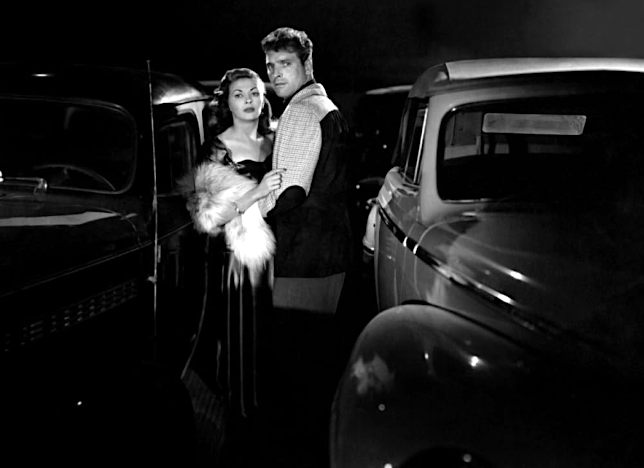
With the camera stationed behind the couple, the audience sees the entire scene from the back seat of the getaway car, which makes viewers not only spectators but virtual accomplices to the crime. 
Although more common today, this kind of offbeat camera placement was more of a novelty in 1950. Of course, “They Live By Night” (1948) includes a robbery scene in which the camera stays trained on the car rather than recording the holdup that's under way. In "The Killers" (1946), a robbery scene is shot in one long take. But neither of those films use the more daring camera placement of "Gun Crazy," putting it inside the moving vehicle and taking us, the audience, along for the ride. 

A narrow escape.
Quentin Tarantino doesn’t specifically mention “Gun Crazy” as a direct influence on “Reservoir Dogs” (1992), or the film's off-screen diamond heist. But he's a “Gun Crazy” admirer [he also cites Stanley Kubrick’s “The Killing” (1956) and Lewis’s “The Big Combo” (1955) as influences] so it’s not a stretch to imagine that he borrowed a page from Lewis’s playbook and left the heist to the viewer's imagination. 
Like “Gun Crazy,” “Reservoir Dogs” focuses on the aftermath of a crime and the relationships among characters rather than the details of the crime itself. Both films were made under tight budgets, so eliminating an extra expense would be an attractive option for both directors.

The "Gun Crazy" bank robbery scene evolved as it was revised and reworked from its original form. Blacklisted writer Dalton Trumbo rewrote MacKinlay Kantor’s script and mostly left the robbery scene intact. Kantor had written a longer, more comedic exchange between Laurie and the policeman, but Trumbo trimmed it down. 

It was Lewis’s idea to make it all one continuous shot, from the pair approaching the bank, to the robbery and finally the getaway, and those may be the film's most revealing moments. While the robbery takes place offscreen we’re given a chance to size up Laurie and calculate her and Bart’s odds of survival. Clearly, neither of them will be robbing banks for long.