|
| At her service. Joan Bennett, Edward G. Robinson, 'Scarlet Street' (1945). |
By Paul Parcellin
Contains spoilers
When “Scarlet Street” premiered 80 years ago this month it was not uniformly praised by critics, and several cities outright banned it due to its dark content. The film hinted at such taboo topics as sex out of wedlock and prostitution, and featured a capital crime that went unpunished in the conventional sense.
New York, Milwaukee, and Atlanta thought it too controversial and forbade local screenings. Bosley Crowther of the New York Times called it “a sluggish and manufactured tale,” while Time magazine called the plot “clichéd,” adding that the story focuses on “dimwitted, unethical, stock characters.”
Times have changed and so has the critical response to the film. In later years Cinema Journal called it “a dense, well-structured film noir,” and the Chicago Reader included the film in its list of the best American films not included on the AFI Top 100. TCM Noir Alley host Eddie Muller includes “Scarlet Street” among his top 25 favorite films noir.
Looking back on it eight decades after its release, “Scarlet Street” is relatively tame compared with contemporary fare, yet it’s understandable that its gritty themes of vice and corruption must have been a shock to the American public in 1945.
Fortunately, preservationists rescued it from public domain purgatory. Kino Lorber’s 2024 release in 4K UHD and Blu-ray is sharp and clear and the sound is crisp. It’s a pleasure to view it as it was meant to be seen upon its release so many years ago.
“Scarlet Street” (1945)
Mild mannered Chris Cross (Edward G. Robinson), a cashier with a flair for art, is unhappily married to shrewish Adele (Rosalind Ivan), who keeps him on a short tether. His life changes one night when he rescues a damsel in distress, Kitty March (Joan Bennett), who’s being accosted on a dark Greenwich Village street.
Coincidentally, earlier that evening Chris glimpsed his boss’s blonde paramour and wondered aloud what it would be like to be loved by a young beautiful woman (love is probably the last thing on the blonde bombshell’s mind). Then fate seemed to drop Kitty, the woman of his dreams, at his feet.
Lies and misunderstandings
Kitty, whom we easily infer is a streetwalker, mistakenly thinks Chris is a prosperous artist. Flushed with the excitement of meeting an attractive woman, he does nothing to dispel her false image of him. In one exchange she hints to starry-eyed Chris that she’s a lady of the night, but he doesn’t get it. He guesses she’s an actress, which she is, but not in the traditional sense.
Later, Kitty’s pimp boyfriend Johnny Prince (Dan Duryea at his smarmiest) hears opportunity knocking and convinces her to take the sucker for all he’s worth, and she does so while keeping Chris teasingly at arm’s length.
 |
| Dan Duryea, Joan Bennett. Kitty and Johnny Prince. |
“Scarlet Street” is a study of the ways people delude themselves, embracing comfortable lies that warm them and offer false hope in their hours of despair.
Misunderstandings abound. Chris mistakenly believes that Kitty might love him, as she strings him along and bleeds him for cash. Johnny is her one true love, Kitty thinks, even when he slaps her around. He lives off of her earnings and calls himself a man of leisure, and sporting a jaunty straw boater he dresses the part.
Flawed first impressions
Johnny and Kitty, out of delusional thinking or plain stupidity, believe that they’ve hit the jackpot with Chris as their patsy. The misconception starts when Kitty and Chris first meet. He’s just been feted by his employer and happens to be gussied up in a tuxedo. That’s enough to convince her that he’s in the chips.
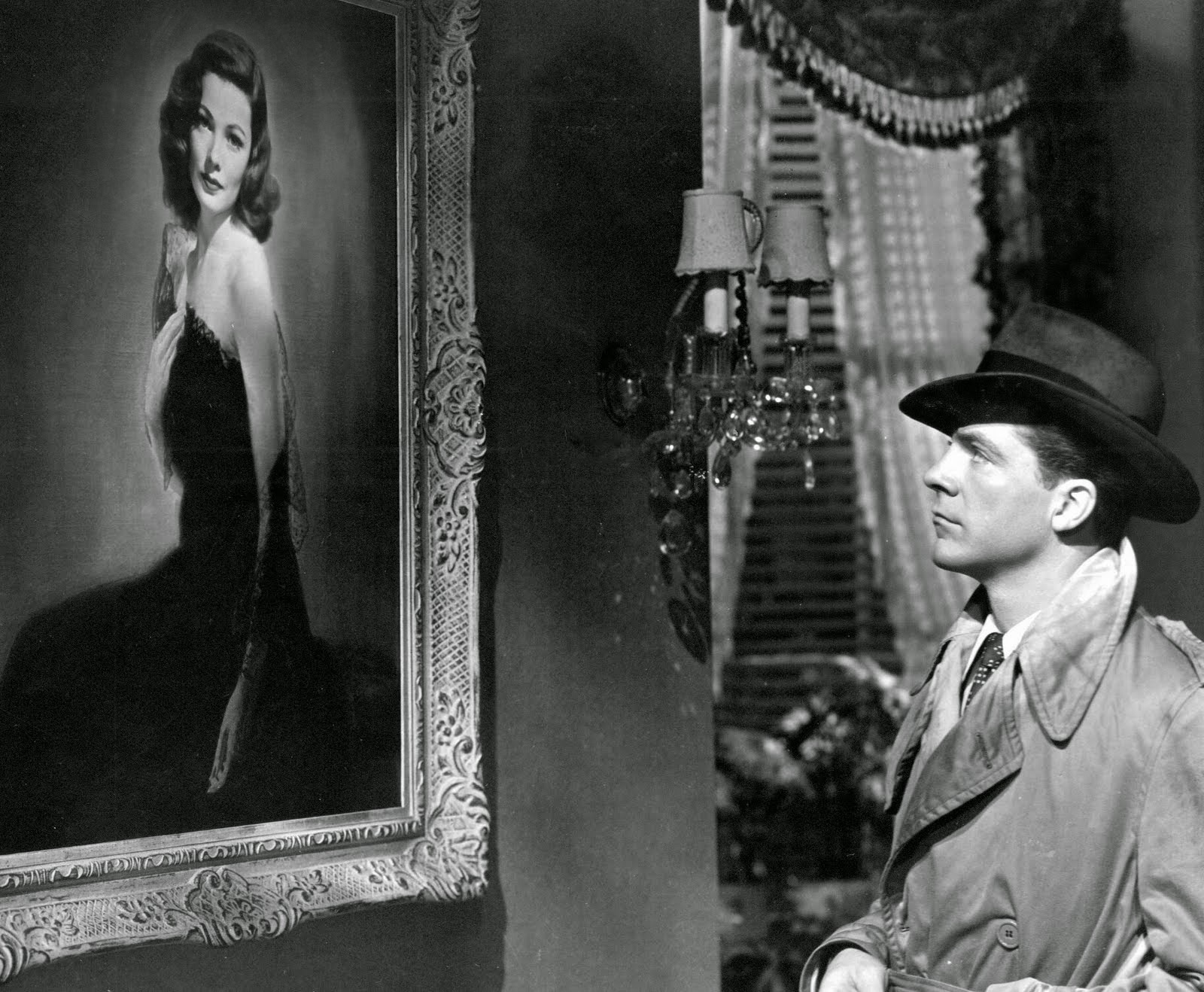
Even Adele is delusional in her idealization of her deceased husband, Patch-eye Higgins (Charles Kemper), a police detective who took an ill-fated dip in the Hudson. She torments Chris with her worshipful praise of the dead hubby while castigating the nebbish painter for his shortcomings. Higgins’s portrait hangs over the mantlepiece as a reminder to Chris of the low esteem in which his wife holds him.
 |
| Chris in exile. A bathroom Rembrandt. |
“Scarlet Street” could be taken as a dark comedy. The same wrong-headed ideas and miscommunications in the hands of, say, Preston Sturges or Ernst Lubitsch, would be uproarious. Here, they are bathed in pathos, even when director Fritz Lang tosses in an occasional chuckle or a sudden upbeat shift in the plot.
In an unexpected turn of events, Chris’s paintings are well received by the art establishment, but only after Johnny schemes to make art-world big shots think that Kitty painted them. The selfless Chris is pleased, not angry, that his paintings are finally being seen, even if Kitty is given credit for them. But he admits that gallery owners wouldn’t be interested if they knew he painted them.
Awarding undue credit
But a beautiful young woman can grab the art world's attention, especially when a respected critic takes a romantic interest in her. Kitty is capable of sleeping her way to the top, but artistic talent is another matter. In the film's pessimistic but probably largely true vision of the art game, we get a hint of the way art stars are made, and how almost inevitably their work ends up in the hands of the undeserving.
The film is based on the French story “La Chienne” (literally The Bitch) by Georges de La Fouchardière. Director Jean Renoir adapted the novel to the screen in “La Chienne” (1931), which presents the female lead, Lulu (Janie Marèse), explicitly as a prostitute, something American production codes at the time would prohibit.
 |
| Chris's portrait of Kitty. |
This is Lang’s second go-around with this cast. In “The Woman in the Window” (1944), Robinson, Bennett and Duryea play roles similar to those in “Scarlet Street.” The story is much the same, too, with manipulative Alice Reed (Bennett) upending the life of Prof. Richard Wanley (Robinson) and crooked ex-cop Heidt (Duryea) making a tragic situation worse.
Both films feature painted portraits of femmes fatale, each inaccessible behind plate glass storefront windows. In both films Robinson is tempted toward adultery and his flirtations result in shattered lives.
Greatly different endings
Adapted from J. H. Wallis's 1942 novel “Once Off Guard,” “The Woman in the Window” has a twist at the end that gives the film an upbeat conclusion, unlike “Scarlet Street,” which comes in for a hard landing, leaving Chris humiliated and psychologically broken.
“Scarlet Street” might seem like an uncompromised do-over of “The Woman in the Window,” yet Lang maintained that the film’s upbeat coda was his choice, not something forced on him. So be it, but clearly, “Scarlet Street” has the better ending.
Dec. 28 marks the 80th anniversary of the “Scarlet Street” theatrical premiere.